ADHD & Autism Training for Counsellors, Therapists, Coaches and Wellbeing Professionals
Neurodivergent-Affirming Practice
Working effectively with neurodivergent clients often requires more than simply knowing the diagnostic criteria for ADHD or Autism.
Neurodivergence can influence how someone experiences emotions, relationships, communication, sensory information, motivation, memory, identity and the therapeutic relationship itself.
These one-day professional development workshops are designed for counsellors and therapists who want to develop greater confidence in understanding and working with neurodivergent clients.
The emphasis is practical as well as theoretical. Alongside accessible psychoeducation, we’ll explore what neurodivergence can actually look like in the therapy room and how we can adapt our practice without losing the foundations of good therapeutic work.
You don’t need to be a neurodivergence specialist to attend.
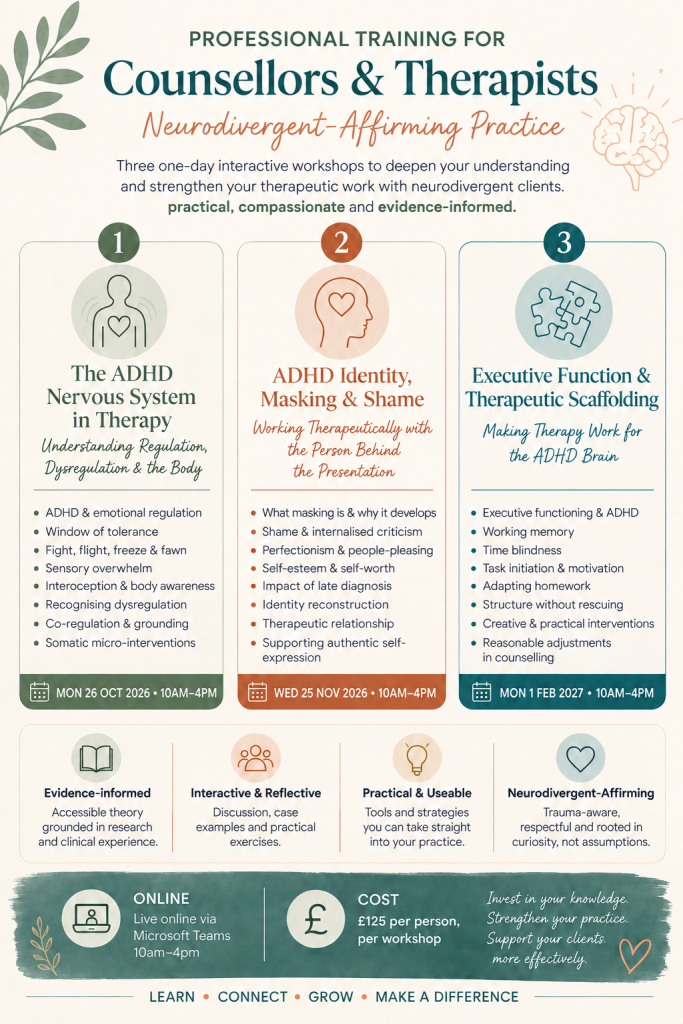
The ADHD Nervous System in Therapy.
Monday 26th October 2026
10am – 4pm Online via Microsoft Teams
Understanding Regulation, Dysregulation & the Body.
A client may know exactly why they feel the way they do and still be unable to regulate what is happening in their body.
This workshop explores ADHD through the lens of emotional and nervous-system regulation and considers how dysregulation may present within the therapeutic relationship.
We’ll explore the window of tolerance, overwhelm, sensory load, fight, flight, freeze and fawn responses, interoception and the relationship between ADHD, stress and trauma.
We’ll also consider how counsellors can begin incorporating simple body awareness, grounding, co-regulation and somatic approaches into their existing practice.
We will explore:
• ADHD and emotional regulation
• The nervous system and window of tolerance
• Fight, flight, freeze and fawn responses
• Sensory overwhelm and overload
• Interoception and recognising internal signals
• ADHD, stress and trauma
• Recognising dysregulation in the therapy room
• Co-regulation and therapeutic presence
• Body awareness and grounding
• Simple somatic interventions that can complement talking therapy
One-day workshop
ADHD Identity, Masking & Shame
Wednesday 25 November 2026
10am – 4pm Online via Microsoft Teams
Working Therapeutically with the Person Behind the Presentation
Many neurodivergent adults arrive in therapy after years of trying to fit in, compensate, perform, please others or hide the parts of themselves that have felt unacceptable.
Some may only recently have discovered that they are neurodivergent.
Others may have spent decades believing that they are lazy, difficult, over-sensitive, disorganised, selfish or simply not trying hard enough.
This workshop explores the psychological impact of living with an unrecognised or misunderstood neurodivergent brain and what this can mean for identity, self-esteem and the therapeutic relationship.
We will explore:
• What masking is and why it develops
• Safety, belonging and adaptation
• Shame and internalised criticism
• Perfectionism and people-pleasing
• Self-esteem and self-worth
• The impact of late diagnosis or identification
• Identity reconstruction and self-understanding
• Anxiety and fear of getting things wrong
• The therapeutic relationship with neurodivergent clients
• Supporting authentic self-expression without making “unmasking” another expectation
The aim isn’t to tell clients who they should become, but to help them understand themselves more fully and make conscious choices about what they want to keep, change or let go of.
One-day workshop
Executive Function & Therapeutic Scaffolding
Monday 1 February 2027
10am – 4pm Online via Microsoft Teams
Making Therapy Work for the ADHD Brain
Sometimes the difficulty isn’t that therapy isn’t helping.
It’s that the way therapy is being delivered places demands on precisely the executive functions the client finds difficult.
A client may forget what happened in the previous session, struggle when asked what they want to talk about, lose track of insights between appointments or repeatedly fail to complete something they genuinely intended to do.
This can easily be misunderstood as avoidance, resistance or lack of motivation.
This practical workshop explores how executive functioning affects the therapeutic process and how counsellors can provide appropriate structure and scaffolding while maintaining client autonomy.
We will explore:
• Executive functioning and ADHD
• Working memory
• Task initiation and motivation
• Time blindness
• Organisation and planning
• Why insight doesn’t always translate into action
• When open-ended therapy can become difficult
• Working with clients who don’t know what to bring to a session
• Adapting therapeutic homework and between-session tasks
• Using prompts, visual tools and creative interventions
• Accountability and body doubling
• Providing structure without becoming directive or rescuing
• Reasonable adjustments within counselling
• Adapting established therapeutic approaches for ADHD brains.
The aim is not to turn counselling into coaching, but to consider how thoughtful adaptations can make therapy more accessible and useful for neurodivergent clients.
One-day workshop
How the Training Works
These are interactive professional-development days rather than lecture-style training.
Each workshop combines theory and research with clinical examples, discussion, reflection and practical exercises that can be taken back into therapeutic practice.
There will be opportunities to think about your own client work, ask questions and explore some of the complexities that can arise when traditional ways of working don’t quite fit the person sitting in front of you.
The training is neurodivergent-affirming and trauma-aware, with an emphasis on curiosity rather than assumptions about what a neurodivergent client should look like or need.
Who Are These Workshops For?
These workshops are particularly suitable for:
• Qualified counsellors and therapists
• Counsellors in training
• Clinical supervisors
• Practitioners already working with ADHD or neurodivergent clients
• Practitioners who are beginning to recognise neurodivergence within their existing caseload
You don’t need previous specialist training in ADHD or neurodivergence.
Register Your Interest
Dates will be arranged according to interest.
You can attend an individual workshop or register your interest in more than one.
Please use the contact form below and let me know which workshop(s) you’re interested in:
☐ The ADHD Nervous System in Therapy
☐ ADHD Identity, Masking & Shame
☐ Executive Function & Therapeutic Scaffolding
Registering your interest doesn’t commit you to attending.
I’ll contact you when dates become available with further information.
Venue & Cost
These one-day professional development workshops will be held in person at Devon Counselling College, providing an opportunity to learn, reflect and share ideas with other practitioners in a supportive environment.
Cost: £125 per person, per workshop.